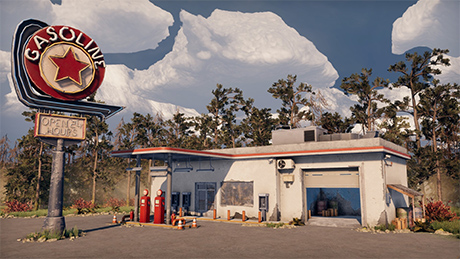
Video sourced from the GAMEAY YouTube channel. © 2026 Indie Devil.
Many post-apocalyptic games focus heavily on narrative. Titles like Days Gone, The Last of Us, or the Fallout series are excellent, but their stories are pre-driven. You often feel like you are helping the characters live out their stories rather than deciding how you would personally survive.
Nomad Drive is different. It puts “me” at the center, forcing you to think about what you would actually do to survive in a wasteland. This makes the immersion much stronger.
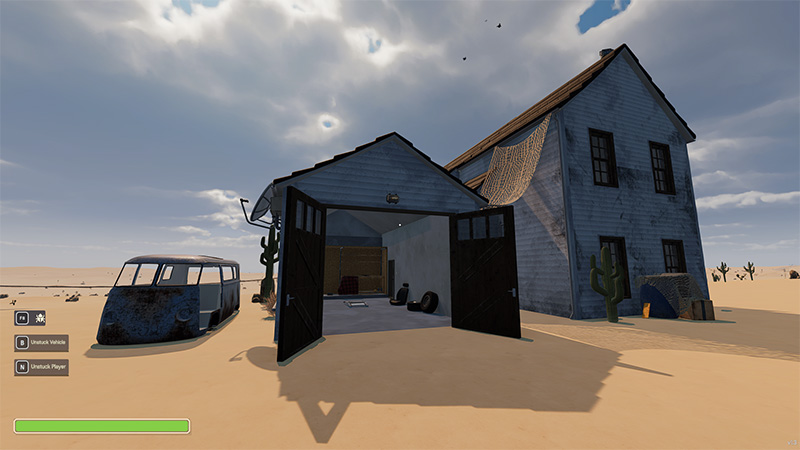
The vehicle mechanic is what attracted me first. You start in a house garage with a completely stripped-down chassis. To build a basic, functional RV, you have to search the house to find the necessary parts: four tires, doors, a steering wheel, a handbrake, an engine, a radiator, fuel, and water for cooling.
Used under fair use for commentary, criticism, and educational purposes.
While the game provides polishing and painting tools for aesthetics, staying alive is the priority in an apocalypse, so I ignored cosmetic customization for later. Survival requires food and water, which are also scattered around for collection. If your vehicle has enough space, you can even move plants you discover onto your truck.
Once prepared, you hit the road. Currently, the environment only consists of a desert, and I assume the map is procedurally generated.
A major piece of advice: stick to the highway and do not drive randomly into the desert, or you will easily lose your direction. Resource buildings generate along the road; the open desert is empty. On top of that, the uneven desert terrain causes vehicle damage.
I once tried speeding from the highway directly into the desert, which caused my tires and doors to fall off instantly. I had to run back to retrieve the tires. If you have enough space, carrying a few spare tires is essential since they have durability and consume over time.
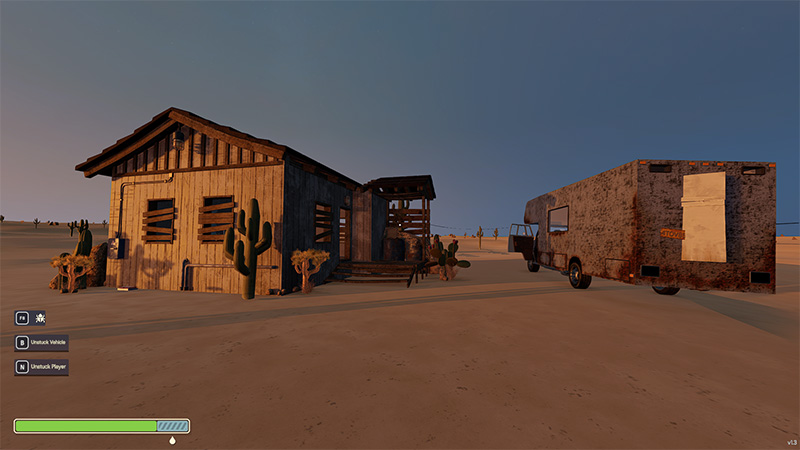
Along the highway, you will encounter structures like gas stations, holiday cabins, factories, abandoned shipping containers, and mining offices. Gas stations contain fuel, food, and batteries. Containers are like blind boxes with unpredictable loot. Mining offices provide useful tools like metal detectors and shovels.
Initially, vehicle storage is very small. However, larger RVs often generate next to these buildings. Since vehicle parts are universally interchangeable, you can transfer your small car’s components onto a larger vehicle to multiply your storage space.
Installing found items like sinks, refrigerators, and toilets inside your vehicle transforms it into a mobile fortress. This progression loop is currently the core of the game and my favorite part.
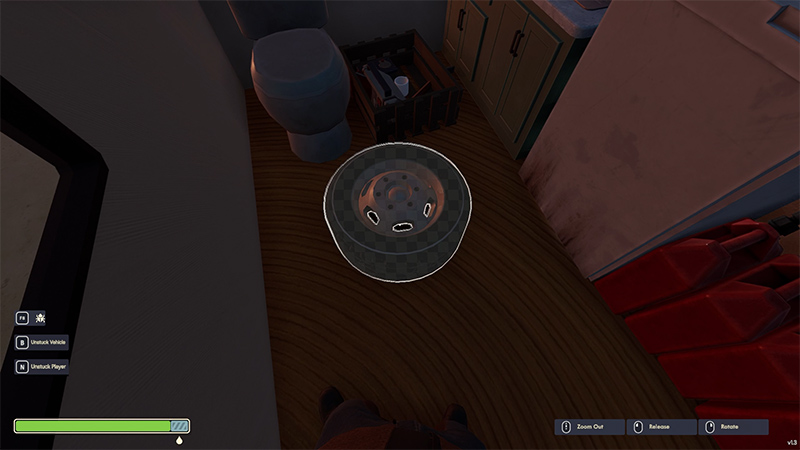
The game also features dynamic tasks. Finding a stove and a pot displays cooking tasks, while finding a coffee machine automatically switches the objective to coffee making, which is quite interesting. The demo lacks a main storyline; the ultimate goal is simply to explore, collect items, and survive. It supports 1-4 player co-op and does not rely on plot progression.
However, the demo content is limited. Resource points sometimes spawn very far apart, and the desert contains nothing but cacti, rocks, and sand, making long-distance driving tedious.
While it is a survival game, there are currently no external threats like enemies or wildlife. As long as you have enough food and water, survival is not an issue, which reduces the apocalyptic tension and makes it feel more like a casual camping trip.
I also encountered several issues during my 2-hour playthrough.
Regarding optimization, my PC specs are decent, but during gameplay, the screen would occasionally freeze for a few seconds before returning to normal. I’m not entirely sure if the issue is on my end or with the game itself, but my hardware configuration should be sufficient.
For clipping issues, when I jumped onto an obstacle right next to a shipping container, the character model got squeezed between them, allowing me to see straight through the geometry and pull a tire out from the inside. It felt like magic.
Then there is the Toilet Seat Bug. You can use a toilet as the driver’s seat. However, because it sits much higher than a normal seat, pressing Q to exit the vehicle would occasionally clip my character into the roof, making me stuck. I had to switch to the normal passenger seat to exit properly. This did not happen 100% of the time, but the probability is there.
The core concept and framework of Nomad Drive are very interesting, and it’s exactly the style of game I enjoy. If the developers add more content later—such as a storyline, enemies, NPCs, more vehicle customization choices, and more buildings or events to explore—it will greatly increase replayability.
I know this would mean a massive amount of development work and might not be entirely realistic, but it’s just the direction I personally hope to see the game take.
This review is based on my impressions after playing the demo for about two hours. I may not have experienced every single detail—for instance, I found a key but didn’t figure out its purpose, though it might be used to unlock chests. Please note that the content of the official full release may differ, so the final official release should be taken as the standard.
As a side note, the Steam page indicates that Nomad Drive is scheduled for release in Q3 2026, though the exact date has not yet been announced.
About the Author