On July 6, 2026, Microsoft officially announced the most sweeping restructuring in Xbox’s history.
According to an internal memo from the recently appointed Xbox CEO Asha Sharma, the division is cutting roughly 3,200 positions through fiscal year 2027, with 1,600 employees laid off immediately.
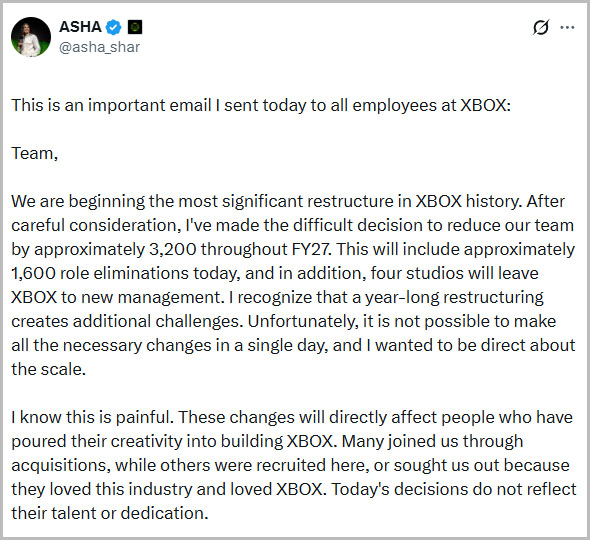
Used under fair use for commentary, criticism, and educational purposes.
As part of this drastic streamlining effort, Xbox is divesting itself of four prominent first-party studios. Compulsion Games and Double Fine Productions are being spun off to become independent again. Meanwhile, Ninja Theory and Undead Labs have signed terms to be transferred to new ownership.
These studio changes directly alter the landscape of Xbox’s upcoming pipeline:
- Double Fine Productions (Psychonauts 2) and Compulsion Games (We Happy Few) will retain their respective IPs, catalogs, and remaining funds, but will no longer have the financial backing of a trillion-dollar tech giant.
- Ninja Theory (Hellblade: Senua’s Sacrifice) and Undead Labs (State of Decay) are moving to undisclosed new buyers. While Microsoft stated these new owners will provide funding to complete Senua’s Saga follow-ups and State of Decay 3, the transition inevitably introduces development uncertainty and potential delays as teams adjust to new management.
- Arkane Lyon (Deathloop, Dishonored), based in France, is also entering a legally required consultation period due to the country’s strict labor laws. This leaves the future of its highly anticipated upcoming title, Marvel’s Blade, entirely up in the air.
This corporate retreat follows a massive hardware blow delivered on June 25, when Xbox announced a global console price hike effective August 1, 2026.
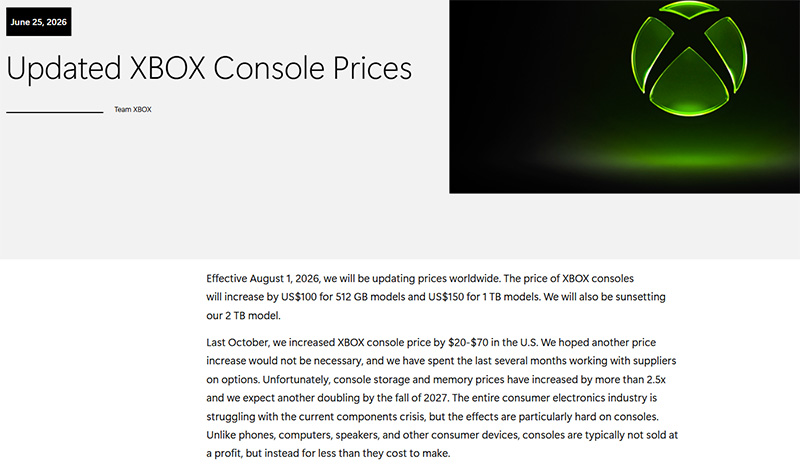
Retail prices are jumping by $100 for 512GB models and $150 for 1TB models, while the high-end 2TB SKU is being entirely discontinued.
Interestingly, these cutbacks came less than a month after the June 8 Xbox Games Showcase, where the company tried to rally fans by celebrating its 25th anniversary with a translucent “Xbox Series X25” limited edition console and promising that major tentpoles like Gears of War: E-Day will be permanent Xbox exclusives.
Why Microsoft is Pulling Back
To understand why Microsoft is executing such a sharp pivot, you have to look at the financial realities outlined in Sharma’s memo. Simply put, the aggressive expansion strategy of the last generation isn’t paying off.
Xbox enters the current landscape with a smaller console install base than its competitors and a significantly higher cost structure.
The massive bet placed on Xbox Game Pass, multi-platform publishing, and broad portfolio acquisitions has failed to grow at the expected pace, leaving Xbox operating at profit margins three to ten times lower than its industry peers.
Compounding this software stagnation is a severe component crisis. Supply chain shifts have driven console storage and memory prices up by more than 2.5 times, with Microsoft expecting costs to double again by late 2027.
Making hardware has become an expensive, unsustainable deficit.
With Microsoft heavily prioritizing corporate investment into artificial intelligence infrastructure, the company is no longer willing to bankroll low-margin gaming experiments or subsidize expensive hardware.
Spinning off mid-tier studios and raising console prices is a cold, calculated move to stop chasing market scale and immediately protect the bottom line.
A Cold Reality Check for the Game Pass Dream
Watching this play out feels like the final nail in the coffin for the “Netflix of gaming” idealism.
Just a couple of years ago, the narrative around Xbox was defined by massive acquisitions like Bethesda and Activision Blizzard, promising an era of unprecedented developer freedom under a seemingly bottomless corporate wallet.
Seeing teams like Ninja Theory—who spent years crafting incredibly bespoke, artistic experiences—and Undead Labs pushed out the door just to balance a corporate spreadsheet is a harsh reminder of how volatile first-party stability can be.
That said, from a purely operational standpoint, this pivot might be the dose of reality Xbox desperately needed.
For years, the brand has suffered from a visible identity crisis, caught between trying to sell hardware, chasing subscription numbers, and porting its own titles to rival platforms like the PlayStation.
By narrowing the focus back to core, permanent first-party exclusives like Gears of War: E-Day and relying on reliable legacy IPs like Halo, Xbox is finally trimming the fat.
It is going to be a tough, expensive pill for consumers to swallow with these upcoming hardware price hikes, but getting a leaner, more focused Xbox is better than watching the brand slowly dilute its identity into irrelevance.
About the Author