The escape pod’s storage was pushing its limits, entirely packed with the minerals I’d scavenged. Expanding my base had become an absolute priority.
But without the necessary room blueprints, I had no choice but to head back out into the blue.
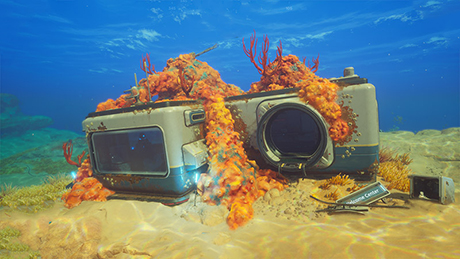
After swimming about three hundred meters, I stumbled upon “Welcome Home”—an old habitat built by my former colleagues. It was completely abandoned.
I have no idea what exactly went down here. At the main entrance, I found Nahima’s log. The despair in her words was palpable, and the door itself was sealed tight from the outside.
Turning to the other side, however, I found an open bulkhead leading into the flooded interior. Fortunately, emergency oxygen tanks were scattered along the corridors, allowing me to top off my tanks as I went.
According to the logs, the entry room used to be Dr. Wu’s research lab. A few culture specimens of the Bloom Virus were still sitting there. In his notes, Dr. Wu mentioned a “Sonic Resonator,” which looks like it will be a crucial tool for my upcoming exploration. He also brought up a massive fire—it’s clear a severe disaster struck this place.
Despite the tragic history, this abandoned habitat was a goldmine. The rooms were cluttered with scannable debris: room modules, battery chargers, desks, chairs, a massive processor, bioreactors, and biological beds. All of this is critical for unlocking new blueprints and getting my own base off the ground.
The few supplies left behind in the storage crates were an absolute lifesaver.
Heading up to the second-floor living quarters, I recovered a Quaker’s log. It confirmed my suspicions: the fire had triggered a catastrophic explosion, completely destroying the facility.
I kept moving upward to the third floor and caught a massive break. Because of the higher elevation, this deck wasn’t flooded, and the life support was still pumping oxygen. I could finally take my mask off and breathe easy.
On a nearby desk lay data from the Cicada, right next to some scanner room fragments. After downloading the data and scanning the wreckage, I headed into the terminal control room to piece together the timeline.
I powered up the NoA system. The system logs revealed that before I was printed, about 25 personnel had lived here. They had planned to establish a fully functional habitat to sustain the survivors of the crashed ship, but they never made it.
On the bright side, NoA successfully pinged the coordinates of Dr. Wu’s black box. That’s my next destination. I have to figure out what caused this disaster if I want to avoid repeating history and survive on this planet.
With the essential blueprints secured, I decided to head back to the escape pod and start building. I need to lay down a solid foundation for the rest of the crew, especially since getting off this rock anytime soon is far from a guarantee.
While the materials I’ve gathered so far filled my existing crates, they are still a drop in the bucket for building a massive base. For now, I’m sticking to the bare essentials.
Just as my resources were running dry, a signal from the RUBY black box came through. I decided to check it out.
Following the ping, I arrived at a cluster of ruined structures. Strange creatures, looking like a cross between an octopus and a jellyfish, were clinging to the tops of the buildings.
Shaky-looking sharks patrolled the perimeter, their eerie cries echoing through the water. It made searching the area incredibly nerve-wracking. Fortunately, my diving suit’s armor held up well; the sharks didn’t do too much damage, but I still wasn’t about to take any stupid risks.
After thoroughly tossing every room and hallway, I managed to find all the scannable fragments I needed, alongside a desperate final log left by TUBA.
The black box itself was still about a hundred meters out. When I finally reached it, I spotted fragments of the Tadpole and scanned them for the blueprint. A massive ship wreckage loomed nearby, but with my oxygen flashing red, I could only tag the location on my HUD and leave it for a future expedition.
Lacking high-end propulsion gear, my return swim was agonizingly slow. I barely made it back to my newly built base.
Power immediately became a glaring issue. The solar panels only work during the day, leaving me completely in the dark at night. Thank goodness the escape pod can still run basic equipment.
There’s a high-velocity current rushing through a nearby cave entrance, and since I just unlocked the hydro-generator blueprint, I grabbed my materials and headed over to set it up. Unfortunately, I could only afford to build one, and its output is pretty limited. Securing a stable power grid remains a top priority.
On the bright side, I finally finished crafting the Sonic Resonator. Not only can it clear the cave openings blocked by those unknown organisms, but it also doubles as a defensive weapon to ward off aggressive wildlife.
With everything prepped, NoA updated the tracking info for the Wander black box, which made explicit mention of a specific virus—my next target.
Following the signal, I blasted open a sealed cave entrance. Inside, a colossal plant smothered in a thick, white substance filled the cavern. This had to be the virus they were talking about.
I smashed a few glowing objects nearby, which immediately triggered an attack from the creature guarding the place. Given my limited oxygen, I wasn’t about to risk dying down there. I grabbed the data from the black box and beat a hasty retreat, making a mental note to come back better prepared.
Back at base, I immediately crafted the Wakemaker. Until I can build a proper vehicle, this should significantly boost my swim speed.
I also finished the Battery Terminal, which is an absolute game-changer for my power-hungry gear. With this online, dead batteries are a thing of the past, even if the base’s overall grid stability still needs work.
This is just the beginning. The people who didn’t make it out of these waters left their unfinished path to me.
About the Author